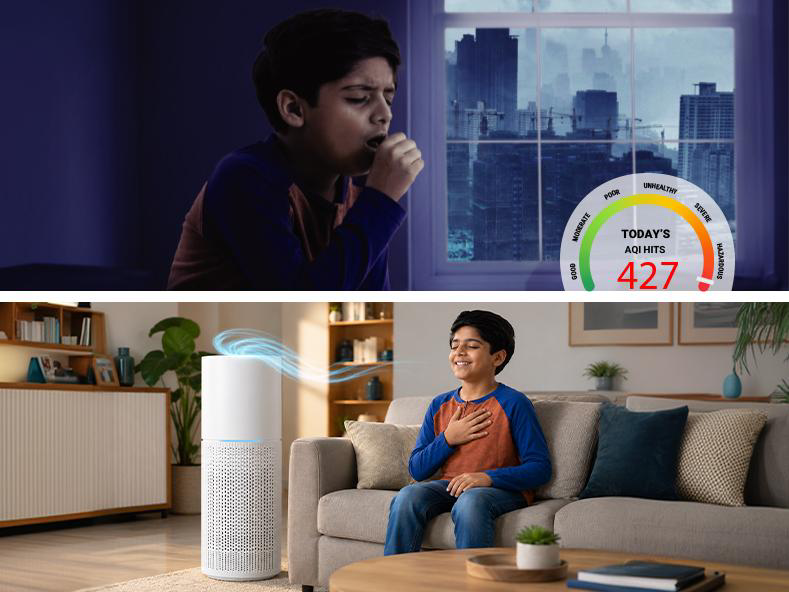
New Delhi [India], June 17: Outdoor air pollution is a major concern in the Indian subcontinent, especially in north indian states. Air quality index in these areas frequently remains in the poor to severe category throughout the year. However, outdoor air quality is important; indoor air quality is equally important, which people often overlook. This can be understood by a fictional story given below.
A man living in the metropolitan city of Delhi never forgets to wear a mask before stepping out. He believes that the air outside is year-round poor and becomes hazardous during the winter season. So, he tries everything he can to maintain his and his family’s health. He would see the AQI on his phone and would shut doors and windows in case of severe air quality. However, he did not pay much attention to the polluted indoor air, which can be harmful to health if exposed for a long period. As awareness grew regarding indoor air pollution, he installed an air purifier for home to improve the indoor air quality.
This blog will explain how indoor and outdoor pollution differ, their contributors and suggest ways to manage indoor air quality.
What is the Air Quality Index (AQI) and What Does it Tell You?
The Air quality index is a standardised tool that governments use to assess the air quality of a particular place. India launched this tool in 2014, which provides AQI based on eight key pollutants, such as:
- Particulate Matter (PM2.5)
- Particulate Matter (PM10)
- Nitrogen Dioxide (NO2)
- Sulfur Dioxide (SO2)
- Carbon Monoxide (CO)
- Ozone (O3)
- Ammonia (NH3)
- Lead (Pb)
It ranks the air quality index on a scale of 0-100, reflecting Good (0-50), Satisfactory (51-100), Moderately polluted (101-200), Poor (201-300), Very Poor (301-400) and Severe (401-500).
However, it should be noted that the air quality index captures half of the picture, as monitoring stations are located at specific locations, highlighting the air quality of a particular area and can only provide a reference for neighbouring areas.
This can be understood through an example: an air quality monitoring station in Greater Noida, installed at Pari Chowk, will reflect the air quality of Pari Chowk, not the AQI of Delta 1.
Also, the air quality index does not tell you anything about the indoor air quality, where there are pollutants like cooking fumes, volatile organic compounds, dust mites and moulds.
Hence, a city may record an AQI between 50-70, the indoor AQI could be above 70.
Indoor Air Quality: What is Making the AQI Poor
What do you observe in an average house in a day? You may find someone dusting, brooming, and cooking, and in some cases, if someone decides to give a makeover to their room, you may find them painting their walls.
This makes the indoor air quality a cocktail of pollutants and gases. Prominent pollutants include:
- Particulate matter (PM2.5, PM10): Emitted from incense sticks, candles, and cooking fumes.
- Carbon Monoxide: Found in gas stoves and heaters.
- Carbon Dioxide: Builds up in closed rooms.
- Volatile Organic Compounds (VOCs): Released from adhesives, cleaning sprays, air fresheners, and paints.
- Biological Pollutants: Released from pet dander, fungal moulds and dust mites
- Formaldehyde: Found in plywood and pressed furniture.
How Outdoor and Indoor Pollutants Differ: Direct Comparison
Outdoor air pollution is largely driven by vehicular emissions, industrial pollution, construction dust and stubble burning. These pollutants are majorly dominated by particulate matter, along with ground-level ozone, carbon dioxide and carbon monoxide.
Indoor pollution, on the other hand, is a cocktail of diverse chemicals and gases with volatile organic compounds layering it on top.
Comparison Between Outdoor AQI and Indoor AQI
- Primary Sources
- Outdoor AQI: Influenced by vehicular emissions, industrial emissions, and construction dust.
- Indoor AQI: Predominantly affected by cooking and cleaning activities.
- Key Pollutants
- Outdoor AQI: Includes nitrogen dioxide (NO₂), particulate matter (PM₁₀ and PM₂.₅), sulfur dioxide (SO₂), carbon monoxide (CO), and ozone (O₃).
- Indoor AQI: Common pollutants include carbon dioxide (CO₂), volatile organic compounds (VOCs), PM₂.₅, and formaldehyde.
- Measurement
- Outdoor AQI: Monitored and reported by government agencies.
- Indoor AQI: Typically measured at the individual or household level.
- Visibility
- Outdoor AQI: Published and updated regularly through public monitoring systems.
- Indoor AQI: Usually displayed through air purifier indicators or personal monitoring devices.
- Control
- Outdoor AQI: Individuals have limited direct control over air quality.
- Indoor AQI: Can be managed and improved through individual actions and indoor air quality measures.
Why Are People More Vulnerable to Indoor Air Pollution and What is it Doing to Their Health?
Indian cooking is rich in flavour and often involves high-heat cooking techniques like deep frying, tempering spices in oil (tadka), and cooking on open flames (mitti ka chulha). These cooking techniques generate a considerable amount of particulate matter.
In case of LPG gas stoves, large amounts of nitrogen dioxide and carbon monoxide is released, especially from compact kitchens and poorly ventilated areas. As per research, gas stoves can push indoor NO2 levels above the outdoor air quality standards within some time.
Other than cooking, there is daily practice of burning agarbatti, dhoop, and incense sticks, dry dusting and brooming contributing to the indoor pollution.
These pollutants have both short-term and long term impact on health:
Short-term impact includes:
- Persistent headache
- Irritation in the eyes, nose and throat
- Worsening allergies and asthma
Long-term impact includes:
- Long-term exposure to pollutants like volatile organic compounds can lead to kidney and liver damage.
- Extended exposure to particulate matter is connected to lung and cardiovascular health issues.
A certain group of people are at a high risk of contracting health issues posed by indoor air pollution, such as:
- Children (developing immune system)
- Elderly individuals (compromised immune system)
- Pregnant women (prolonged exposure to VOC and particulate matter is related to adverse effects on birth)
- People with asthma, COPD, bronchitis and other respiratory issues.
For such people, maintaining better indoor air quality with proper ventilation, regular cleaning and use of an air purifier can reduce exposure to air pollutants.
Practical Steps to Manage Indoor Air Pollution
Improving indoor air quality does not always require one to take extreme measures. Certain small and consistent steps can be taken to control indoor air pollution.
These steps include:
- Use of an exhaust or chimney while cooking to prevent cooking fumes from staying indoors.
- Proper ventilation is required, meaning keeping windows open for some time unless the outdoor air quality is severe.
- Use of wet dusting instead of dry dusting to prevent dust particles from scattering.
- Thorough cleaning to prevent mould and fungal infection at home.
- One of the most important ways to ensure indoor air is purified properly is buying an air purifier. The best ones come with four stages of filtration, including a pre-filter, HEPA filter, activated carbon filter and plasma filtration. Additionally, replacing air filters at a periodic interval helps maintain the performance of air purifiers over the years.
However, while buying the best air purifier for home, instead of just focusing on the air purifier price, it is advisable to consider certain factors such as space and existing air quality, and then make a decision of purchasing an air purifier for home.
Conclusion
Many people feel assured when they see an AQI of 55 on their phone. However, it reflects the outdoor air quality only. Indoor air quality may vary from outside, and it is just as important as outdoor air quality. For this, several steps mentioned above, such as installing an air cleaner, maintaining ventilation, and using exhaust, can be done to maintain the health and well-being of your family.